‘Who can solve Iran’s many problems?’; created the fire, claims the hose
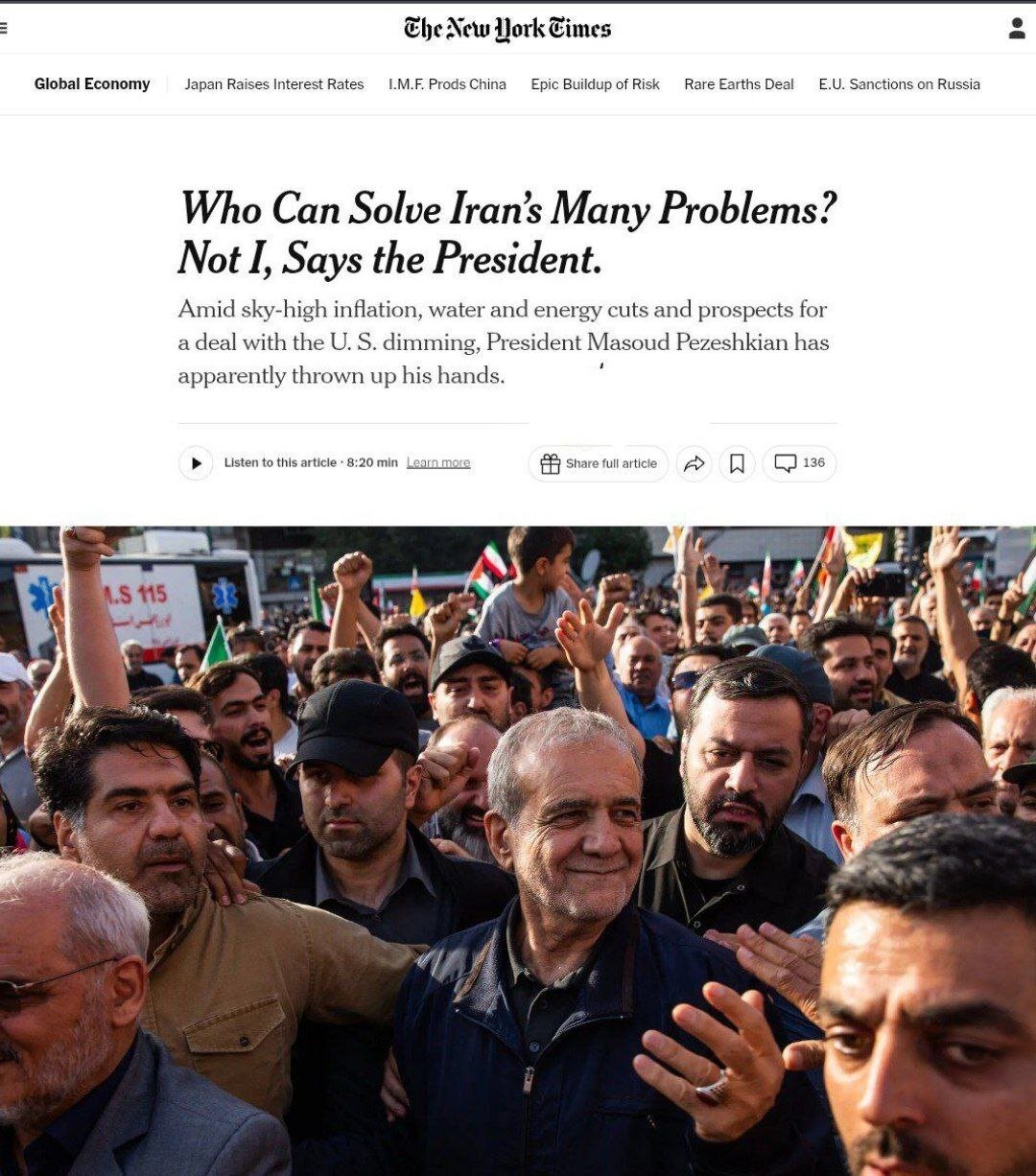
A recent New York Times’ report on Iran , titled “who can solve Iran’s many problems? Not I, says the president”, is not an attempt to grapple with the country’s complex economic and political realities. It is a carefully constructed narrative exercise—one that deliberately removes decisive external factors in order to assign responsibility for Iran’s challenges in a narrowly defined, politically convenient way. What emerges is not journalism in the classical sense, but narrative warfare by other means.
This report does not exist in a vacuum. It is published at a moment when pressure on Iran has shifted form, not disappeared; when overt military confrontation has failed to deliver desired outcomes; and when the battlefield has increasingly moved from missiles and sanctions to perception, legitimacy, and social cohesion.
The omission of the culprit
The report appears while U.S. sanctions on Iran’s economy remain firmly in place. Energy exports, banking transactions, shipping, insurance, and access to international financial systems are still heavily restricted. In recent months, sanctions have not been lifted but rebranded, repackaged, and expanded through new mechanisms and enforcement tools.
Yet this structural reality is treated as peripheral. Instead, Iran’s economic pressures are framed almost exclusively through domestic governance, leadership competence, and internal political dynamics. The result is a story that begins midway through the causal chain—after the decisive external constraints have been quietly removed from view.
Iran is subject to one of the most comprehensive sanctions regimes in modern history. These restrictions limit access to foreign currency reserves, obstruct international banking, deter foreign investment, and complicate even humanitarian trade. Their effects are cumulative, long-term, and structural.
Omitting this context is not a neutral editorial choice. It is an act of narrative engineering. By stripping sanctions from the analysis, the New York Times converts externally imposed economic warfare into an internally generated crisis. Responsibility is reassigned, and causality is inverted.
This approach mirrors a broader pattern in Western media coverage of sanctioned states: sanctions are treated as background noise, while their consequences are foregrounded as evidence of internal failure.
International data contradicts this framing. Reports from institutions such as the International Monetary Fund demonstrate that periods of reduced sanctions pressure have coincided with measurable improvements in Iran’s economic performance. The years following the nuclear agreement saw growth, increased oil exports, currency stabilization, and improved fiscal outlooks.
These are not contested facts. They are documented trends. Yet they are incompatible with a narrative that seeks to portray Iran’s problems as detached from Western policy choices. Consequently, they are omitted. Journalism that selectively ignores available data is not incomplete—it is directive.
Media behavior before and after the 12-day war
The significance of this report becomes clearer when placed against recent history. In the lead-up to the 12-day war, segments of the American media ecosystem effectively became extensions of U.S. and Israeli strategic messaging.
A prominent example was the sustained promotion of alleged tensions between Donald Trump and Benjamin Netanyahu. Headlines, analyses, and “informed sources” suggested deep disagreements and strategic divergence. This narrative was later revealed to be part of a deception operation designed to reduce vigilance and create strategic ambiguity.
Media participation in this operation was not incidental. By amplifying selective leaks and speculative interpretations, outlets helped manufacture an atmosphere of diplomatic friction that did not, in practice, exist.
The objective was clear: surprise. Political and military deception depends on shaping expectations, and media narratives are essential tools in that process. By projecting discord between Washington and Tel Aviv, the groundwork was laid for miscalculation.
That strategy failed. Iran was not strategically paralyzed, and the war did not deliver its intended results. Despite material destruction and civilian suffering, the core political and security objectives of the attacking side remained unmet.
During Israel war, Perhaps the most consequential failure was internal. Expectations of mass unrest and societal fracture inside Iran proved unfounded. Instead of the predicted uprising, the conflict produced an unexpected surge of national solidarity.
Public divisions narrowed. Social cohesion strengthened. The gap between state and society—assumed to be exploitable—did not collapse into open confrontation. For planners who had invested heavily in that outcome, this was a strategic setback. It also marked a turning point.
With military shock failing to trigger internal breakdown, the strategy evolved. The new objective became long-term erosion rather than immediate collapse. Instead of explosions, narratives. Instead of shock, fatigue. Instead of confrontation, alienation.
This is the context in which the New York Times report must be read. It is not simply an assessment of governance or economic performance. It is part of a broader effort to redirect public frustration inward, to deepen cynicism, and to frame political leadership as structurally incapable.
Within this framework, the portrayal of Iran’s president is revealing. Statements acknowledging constraints imposed by sanctions and international pressure are selectively reframed as admissions of impotence. Political realism is recoded as abdication of responsibility.
This is a familiar technique. Leaders in sanctioned states are rarely allowed the analytical space granted to their Western counterparts. Structural constraints become personal failures; external pressure becomes internal weakness. The purpose is not clarification, but delegitimization.
A consistent double standard
The contrast with Western media coverage of domestic crises is striking. When inflation surges in Europe or the United States, explanations abound: pandemics, wars, energy shocks, supply chain disruptions, geopolitical instability.
When Iran experiences similar or greater pressures under far harsher conditions, explanation gives way to attribution. The same media outlets that contextualize Western hardship personalize Iranian difficulty.
This asymmetry is not accidental. It reflects political alignment, not journalistic rigor.
The collapse narrative also struggles with inconvenient facts. Despite sanctions, Iran has maintained critical infrastructure, expanded non-oil exports, and achieved measurable advances in domestic technology and industrial capacity.
These developments do not negate existing problems, but they complicate the story. And complexity is precisely what narrative warfare seeks to avoid.
A population portrayed as exhausted, disillusioned, and leaderless is easier to manipulate than one understood as resilient and adaptive.
Viewed holistically, the New York Times report functions less as analysis and more as a pressure multiplier. It complements sanctions by amplifying their psychological impact. It reinforces military pressure by extending conflict into the informational domain.
This is not an isolated case. It reflects a broader shift toward hybrid strategies in which media narratives are deployed alongside economic and military tools to shape outcomes without direct confrontation.
At its core, the strategy targets cohesion. The assumption is simple: if unity cannot be broken through shock, it can be eroded through doubt. If confrontation fails, attrition may succeed.
By portraying leadership as ineffective, institutions as hollow, and resistance as futile, such narratives seek to manufacture alienation over time.
Iran’s challenges are real. They are complex, layered, and shaped by both internal decisions and external pressures. What is not real is the New York Times’ portrayal of those challenges as detached from the policies that have shaped them.
By erasing sanctions, distorting political realism, ignoring recent history, and selectively deploying data, the report crosses the line from journalism into narrative warfare. After the failure of military and shock-based strategies, perception has become the new battlefield.
This report is not a neutral observation of that battlefield. It is part of the campaign itself.
Leave a Comment